Rebuilding Lives After Violence: Lessons from Allies in Development’s Livelihood Support Programme
Why do survivors of intimate partner violence remain in abusive relationships? Why do children who experience rape or other forms of abuse by family members often remain silent? The reasons are complex and deeply interconnected. They include limited awareness of rights, lack of access to support services, weak survivor support systems, fear of stigma, self-blame, disability-related barriers, and the absence of family or community backing.
Feedback from in-depth interviews with over 30 beneficiaries of the Allies in Development Survivors’ Livelihood Support Programme reveals a critical insight: survivors of intimate partner violence, and caregivers of child survivors, are significantly more likely to report abuse or leave violent environments when they believe their lives will be better off in the long term.
What does “better off” mean for survivors?
For survivors, being “better off” goes beyond immediate safety or justice. While personal security and accountability for perpetrators are important, many survivors define recovery as the ability to rebuild their lives after abuse. This includes access to safe and independent housing, stable employment, financial security, and the ability to provide for themselves and their dependents. It also includes rebuilding social ties and gaining acceptance and support from family and community.
In a highly patriarchal context such as Sierra Leone, where men often control household resources and decision-making, economic independence plays a decisive role. In some rural communities, for example, landlords refuse to rent homes to women without a male guarantor. When a woman believes she can achieve economic stability and stand on equal footing with men, she is far more likely to leave environments where abuse is perpetrated.
Economic independence and social inclusion
Female-headed households are becoming increasingly common in Sierra Leone, and women with financial capacity are often afforded greater respect, particularly within extended family structures. Data from the 2015 Population and Housing Census indicate that 28 percent of households in Sierra Leone are headed by women. Economic independence lowers many of the silent barriers to social inclusion and autonomy.
However, achieving financial independence is especially difficult for survivors who were not income earners in abusive households, particularly women without income generating skills or access to capital. For these women, leaving violence often marks the beginning of poverty rather than safety.
The transition from violence to poverty
When survivors leave abusive homes, they frequently lose household income and critical family support, especially when the perpetrator is the primary provider or protected by family structures. Without the skills, assets, or opportunities to generate independent income, many survivors fall into poverty. For some, this loss directly threatens their ability to feed themselves and their children, reinforcing cycles of vulnerability and dependence.
Bridging the economic gap
In Sierra Leone, there are currently no formal public interventions dedicated to the economic empowerment of survivors of family violence. The country allocates approximately 0.7 percent of GDP to social protection, placing it among countries with the lowest investment in social welfare globally. While civil society organizations such as Rainbo Initiative, and Don Bosco fambul provide critical psychosocial support, temporary shelter, food, and clothing, there are no structured programs that address survivors’ long-term livelihoods.
Filling the gap: Allies in Development’s response
To address this intersection of violence and poverty, Allies in Development established the Survivors’ Livelihood Support Programme. The programme supports women survivors of intimate partner violence and child sexual abuse to rebuild their lives through economic empowerment, restoring dignity, autonomy, and household stability.
Our approach combines three targeted forms of support, delivered based on individual need and readiness:
- Skills development scholarships
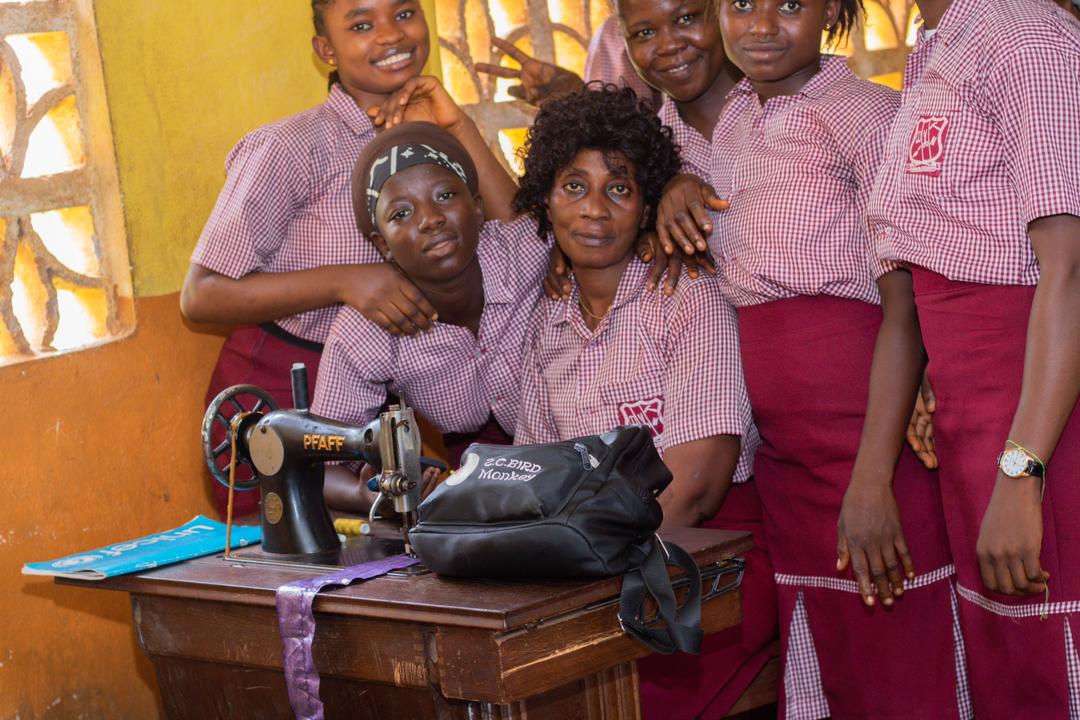
We provide scholarships that enable women to train at accredited vocational centres in trades such as tailoring, hairdressing, catering, weaving, tie-dye production, and small-scale craftsmanship. These skills are aligned with local market demand and equip survivors with practical income-generating abilities. - Small business grants
Survivors who complete training or demonstrate business readiness receive small grants to start or strengthen micro-enterprises. These grants help cover tools, equipment, and start-up costs, enabling women to translate skills into sustainable livelihoods. - Temporary family allowances
During periods of transition, we provide short-term family allowances to stabilize households while women are in training or establishing businesses. This support ensures that basic needs, such as food, healthcare, and school expenses, are met without forcing survivors into unsafe coping strategies.
Impact and broader outcomes
To date, the programme has supported over 40 women across two districts in Sierra Leone, with impact extending beyond direct beneficiaries to their children and dependents. By restoring livelihoods lost to violence, the programme strengthens household resilience, reduces reliance on external assistance, and contributes directly to improved food security.
Contribution to the Sustainable Development Goals
At its core, the Survivors’ Livelihood Support Programme contributes directly to:
- SDG 1: No Poverty
- SDG 2: Zero Hunger
- SDG 5: Gender Equality
Through survivor-centred economic empowerment, Allies in Development is helping to break interconnected cycles of violence, poverty, and hunger, one household at a time.
Support our work
You can support this work by:
- Joining our advocacy efforts calling on government to expand social protection coverage for survivors of sexual and gender-based violence.
- Hosting a fundraiser; or
- Making a donation to support survivor’s livelihood development.
For partnerships or support, contact us at contact@alliesindevelopmentsl.org